The 5 principles of money most people ignore
 Ray Fong · Updated November 22, 2026
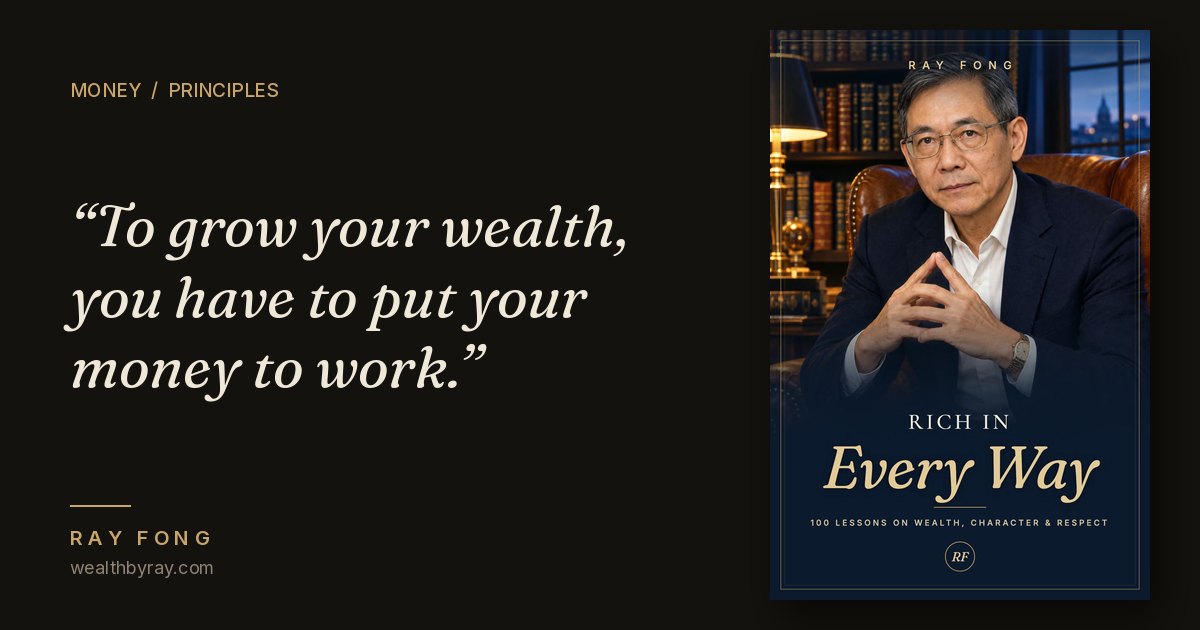
The five principles of money are: believe it is possible, treat time as your most valuable resource, learn how money really works (saving, investing and business), choose the people around you carefully, and take calculated risks. Most people skip the third and the fifth: they never learn how money grows, and they keep everything where it feels safe and earns nothing.
Ray explains it in under two minutes.
You will not get rich if you never learn the five principles of money. Most people ignore them, not because they are hard, but because nobody ever said them out loud.
To grow your wealth, you have to put your money to work.
1. Mindset: believe it is possible
If you think money is out of reach, it always will be. This is not magic. People who believe a thing is impossible never read the first book, never open the account, never ask for the raise. Belief is what gets you to do the boring first step.
2. Master your time
Time is the only thing you cannot buy back. An hour spent learning a skill pays for decades. An hour spent scrolling pays nobody you know. Wealthy people guard their calendar the way most people guard their wallet.
3. Financial education: the three money trees
Most people only know one way to get money: work for it. There are three trees worth planting.
- Saving: the seed. Without it there is nothing to plant. Keep it somewhere insured.
- Investing: money that earns while you sleep. $500 a month for 30 years at a 7 percent average return grows to about $600,000, and you only put in $180,000 of it. Returns are never guaranteed.
- Business: owning something that other people pay for. It is the hardest tree to grow and the one behind most large fortunes.
4. Your circle
You become who you sit with. If everyone around you spends everything they earn, saving feels strange. Find two or three people who talk about building, not just buying, and spend more of your time there. You do not have to drop anyone. You just have to choose where your hours go.
5. Calculated risk (the one that matters most)
Many people stay where they are because they play it safe with everything. Money that sits still loses to rising prices every year. Calculated does not mean reckless:
- Build a cushion of a few months of expenses first.
- Only risk money you will not need for years.
- Spread it out instead of betting on one thing.
- Understand what you are buying. If you cannot explain it, wait.
The people who get this wrong usually fail on the other side too: they avoid sensible risk for years, then put everything into whatever is trending.
The Quiet Rules
Ray’s free book: the quiet money rules his father taught him, written plainly.
Read it free →Questions people ask
What are the 5 principles of money?
Mindset, mastering your time, financial education, your social circle, and taking calculated risks. The fifth matters most, because money that never takes any risk does not grow.
What are the three money trees?
Saving, investing and business. Saving is the seed, investing lets money earn while you sleep, and a business is something you own that other people pay for.
What is a calculated risk with money?
A risk you take after building a cash cushion, with money you will not need for years, spread across several things, and only in something you understand.
How much does $500 a month grow to in 30 years?
At a 7 percent average annual return, about $600,000, of which $180,000 is your own contributions. Returns are not guaranteed and vary year to year.
General education, not financial, legal or tax advice. Rules vary by state and country; speak with a licensed professional about your situation. About Ray.