Loneliness after retirement: how to stay social, and why getting older should never mean disappearing
 Ray Fong · Updated November 7, 2026
Loneliness after retirement usually comes from slow withdrawal, not one event: work friendships fade and invitations get declined one at a time. The fix is structure. Keep something on the calendar every week that involves other people (a class, a volunteer shift, a standing lunch), say yes to invitations by default, and reach out first. About one in three U.S. adults aged 50 to 80 report feeling lonely, so you are far from the only one.
Ray explains it in under two minutes.
One of the quietest ways people age has nothing to do with wrinkles or gray hair. It’s the slow step back from life. If you feel lonely after retirement, or you’re retired and lonely and can’t quite say when it started, this is usually how it happened.
It never happens all at once. You decline one invitation because you’re tired. You skip the new restaurant because the old one is fine. You stop calling a friend, then forget why you stopped. You put the good jacket back in the closet. One day you tell yourself you’ve already seen enough, done enough and lived enough.
I’ve watched it happen to men I admired. Don’t let it happen to you.
Why so many people feel lonely after retirement
Work gives you people without effort. Colleagues, a reason to dress, a place to be at nine o’clock. Retirement removes all of that on a single Friday afternoon, and few people replace it on purpose.
It is common. In the University of Michigan’s National Poll on Healthy Aging, about one in three adults aged 50 to 80 said they felt lonely in 2024, and nearly as many felt isolated. And it isn’t only a feeling. The U.S. Surgeon General’s 2023 advisory compared the health risk of lacking social connection to smoking up to 15 cigarettes a day.
10 ways to stay social after retirement
- Put one thing with other people on the calendar every week. A class, a club, a standing lunch. Structure beats willpower.
- Say yes by default. You’ll rarely regret going. You’ll often regret staying home.
- Reach out first. Friendships don’t usually end in an argument. They end in silence. Call the friend you haven’t seen in months.
- Volunteer with a schedule. A weekly shift gives you colleagues again, and a reason to show up.
- Learn one new skill in a room with others. A language, an instrument, a sport. Being a beginner again keeps you humble and keeps you young.
- Become a regular. The same café, the same morning walk, the same gym hour. Familiar faces become conversations.
- Have dinner somewhere beautiful. Not to celebrate anything. Just because a beautiful room still has something to give you.
- Walk a neighborhood you’ve never explored, and travel when you can. New streets and new faces wake up parts of the mind that routine puts to sleep.
- Mix the generations. Mentor, tutor, or simply spend real time with grandchildren. Younger people keep you current, and you have decades of lessons they need.
- Tell someone if it’s getting heavy. Loneliness that turns into low mood is worth raising with your doctor. It is a health matter, not a weakness.
Dress well, for yourself
Not to impress anyone. Taking care of your appearance is a daily reminder that you are still taking part in life. A pressed shirt, polished shoes and a good coat change how you stand and how you walk into a room.
Don’t save your best clothes for a day that may never come. Today is the occasion. (Dressing well isn’t the same as dressing loud. The best-dressed men I knew never wore a logo.)
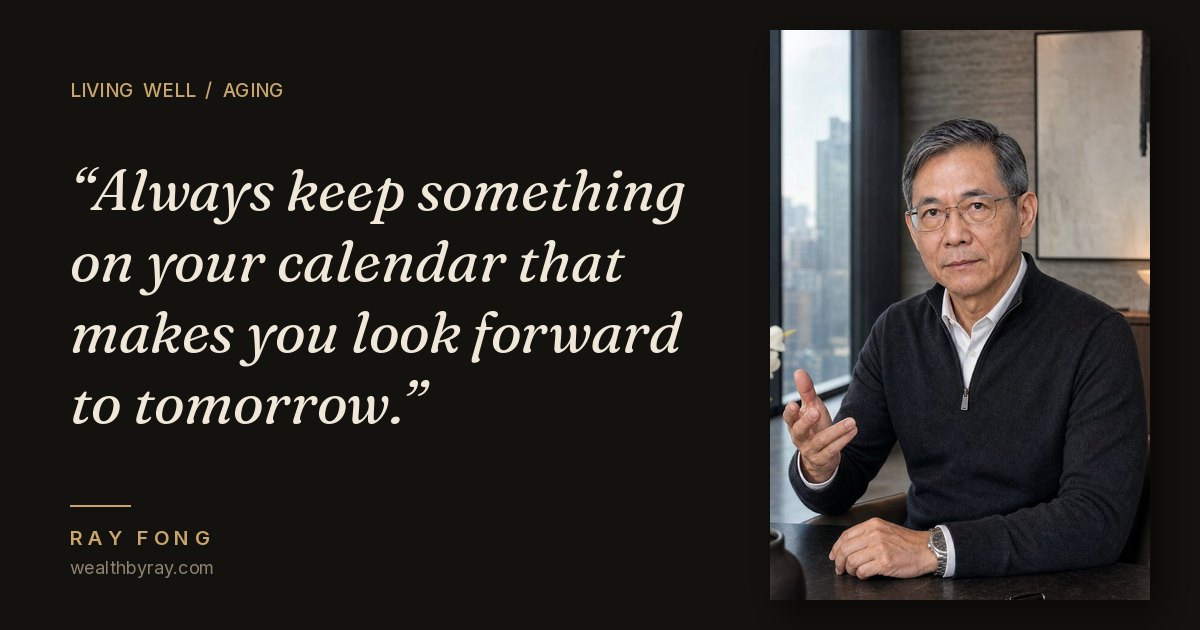
Always keep something on your calendar that makes you look forward to tomorrow.
A word of caution
Lonely people are exactly who scammers look for. Romance scams, “new friends” online and sudden investment tips arrive at the moment someone wants connection most. Americans over 60 lost hundreds of millions of dollars to romance scams alone in 2025. Make friends in rooms, not in your inbox, and read the scams targeting older adults right now.
Protect more than your health
Everyone tells you to protect your health after 50, and they’re right. But protect your curiosity, your friendships and your excitement for what’s ahead too. A man with a strong heart and nothing to look forward to is still getting old.
There is no age at which you become too old to start another beautiful chapter. The years will pass either way. Make sure you’re still living while they do.
The Quiet Rules
Seven rules from Ray’s notebook on living well, money and people. Free.
Read it free →Questions people ask
What should I do if I'm retired and lonely?
Start small and on a schedule: one activity with other people every week, such as a class, a volunteer shift or a standing lunch. Say yes to invitations by default, contact one old friend this week, and talk to your doctor if low mood lasts.
How common is loneliness after retirement?
Common. In the University of Michigan’s National Poll on Healthy Aging, about one in three U.S. adults aged 50 to 80 reported feeling lonely in 2024, and roughly 29% reported feeling isolated.
How can retirees make new friends?
Join something that meets on a schedule (a class, a volunteer shift, a club or a sports group), become a regular somewhere, and take the first step by inviting someone for coffee. Repetition is what turns acquaintances into friends.
Is loneliness bad for your health?
Yes. The U.S. Surgeon General’s 2023 advisory linked social disconnection to higher risks of heart disease, stroke, dementia, depression and early death, comparing the mortality risk to smoking up to 15 cigarettes a day.
What can I do today if I feel isolated?
Call or message one person you’ve lost touch with, and put one activity with other people on your calendar for this week. If low mood persists, talk to your doctor.
- Michigan Medicine: 1 in 3 older adults still experience loneliness and isolation (National Poll on Healthy Aging, 2024)
- NPR: America has a loneliness epidemic (U.S. Surgeon General advisory, 2023)
- National Institute on Aging: Loneliness and social isolation, tips for staying connected
- FBI IC3 2025 Annual Report (romance scam losses, age 60+)
Watch the reel this post came from →
General education, not financial, legal or tax advice. Rules vary by state and country; speak with a licensed professional about your situation. About Ray.