Payable-on-death account vs. living trust: which does your family need?
 Ray Fong · Updated October 29, 2026
A payable-on-death (POD) designation is a free form at your bank that passes one account straight to the person you name, outside probate. A living trust costs more to set up but can hold your house, investments and accounts together, and it lets someone manage them if you become unable to. For a simple estate with one or two accounts and adult beneficiaries, POD is often enough. With a home, minor children, several beneficiaries or concerns about incapacity, a trust usually does the job better.
When I was young I thought you needed a lawyer and a lot of money to keep your family out of court. Then a banker showed me a one-page form. I signed it in two minutes. That form did more for my wife than anything else I owned at the time.
But one page can only do so much. Here is the honest comparison.
What a POD account does
You keep full ownership and control of the account while you’re alive. The person you name has no access and no say. When you die, they bring a death certificate and ID to the bank, and the money is theirs, usually within days and without probate. Brokerage accounts have the same idea under a different name: transfer on death, or TOD. Some states also allow a transfer-on-death deed for a house.
What a living trust does
A revocable living trust is a legal container you control while you’re alive. You move your accounts and often your home into it. You name a successor trustee who takes over when you die, or if you can no longer manage things, and who follows your written instructions. That last part is the big difference: a POD form does nothing while you’re alive and ill. A trust does.
Side by side
| POD / TOD | Living trust | |
|---|---|---|
| Cost | Usually free | Attorney fees; often a few times the cost of a simple will |
| Avoids probate | For that account only | For everything properly moved into it |
| Covers your home | Only where a TOD deed is allowed | Yes |
| Helps if you can’t manage your affairs | No | Yes, your successor trustee steps in |
| Conditions (age, purpose) | No, it passes outright | Yes, you can set rules |
| Privacy | Private | Generally private |
The FDIC rule worth knowing
Since April 1, 2024, the FDIC treats POD accounts and trust accounts under one category. Deposits are insured up to $250,000 per owner, per named beneficiary, for up to five beneficiaries, so a maximum of $1.25 million per owner at each bank. Name more than five beneficiaries at one bank and the extra ones don’t add coverage. If your balances are large, spread them across banks.
Five POD mistakes that send money back to court
- The beneficiary dies first and you never update the form. The money usually falls into your estate and probate after all. Name a backup where the bank allows it.
- You name a minor. A child can’t take the money directly, and a court may need to appoint someone to manage it.
- Balances change, fairness doesn’t. You name one child on savings and another on checking, then the checking account shrinks. Your will’s “equal shares” won’t fix it, because POD overrides the will.
- Forgetting incapacity. If you have a stroke, no one can pay your bills from a POD account. You also need a durable financial power of attorney.
- Confusing POD with joint ownership. Adding a child as a joint owner gives them access now, and exposes the account to their creditors and divorce. POD doesn’t.
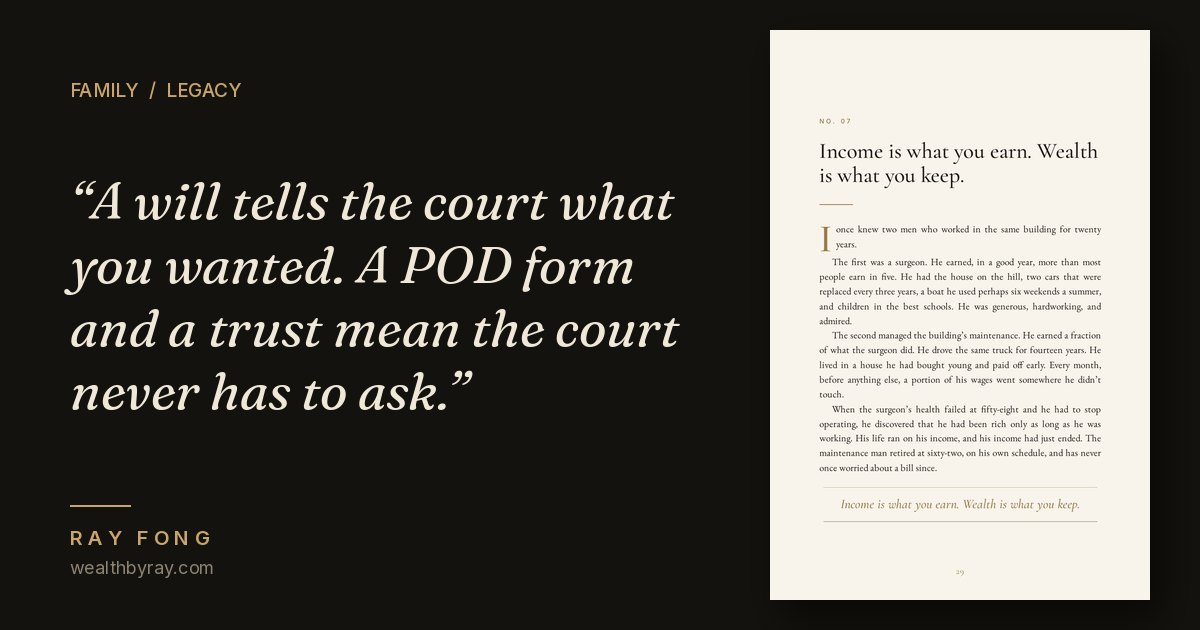
A will tells the court what you wanted. A POD form and a trust mean the court never has to ask.
A simple way to decide
- POD is often enough if you rent or your state allows a TOD deed, you have a few bank and brokerage accounts, and your beneficiaries are responsible adults.
- Consider a trust if you own a home in a state without TOD deeds, own property in more than one state, have minor or vulnerable beneficiaries, a blended family, or worry about who would manage things if you couldn’t.
- Many families use both: a trust for the house and investments, POD or TOD on smaller accounts, and a short pour-over will as a safety net.
Next: why a will alone doesn’t keep your family out of court and what a revocable trust does, and doesn’t, protect you from.
To see what probate would cost if you did nothing, try the free California probate fee calculator.
The Quiet Rules
Seven rules from Ray’s notebook on money, privacy and family, free.
Read it free →Questions people ask
Does a payable-on-death account avoid probate?
Yes, for that account. The money passes directly to the named beneficiary, usually within days, as long as the beneficiary is alive and able to receive it.
Does a POD beneficiary override my will?
Yes. The bank pays the named POD beneficiary regardless of what your will says, so keep your POD designations consistent with your overall plan.
How much does the FDIC insure on a POD or trust account?
Since April 1, 2024, up to $250,000 per owner for each eligible beneficiary, for up to five beneficiaries, which is a maximum of $1.25 million per owner per insured bank.
Is a living trust better than a POD account?
Not always. A POD account is free and simple for straightforward accounts. A living trust costs more but covers your home and other assets together and lets a successor trustee act if you become incapacitated.
General education, not financial, legal or tax advice. Rules vary by state and country; speak with a licensed professional about your situation. About Ray.