How to talk to your adult children about inheritance
 Ray Fong · Updated October 29, 2026
Have the first conversation while you’re healthy, and start with your values and your plan, not with numbers. Tell them who will be in charge (executor, trustee, power of attorney), where the papers are, and what you intend for each of them, especially anything that isn’t equal. You don’t have to share exact amounts. Then keep talking every few years as things change.
My father never told us anything. When he died, my sister and I spent a week going through drawers, and the hardest thing we found wasn’t a bill. It was a note in his handwriting that said the boat goes to Ray. My sister had always loved that boat. A note isn’t a will, and it nearly cost us each other.
Families rarely fall apart over money. They fall apart over surprises.
Why the silence is so expensive
When children know nothing, they fill in the blanks themselves. One assumes the house will be sold, another assumes they’ll live in it. One thinks Dad was rich, another thinks he was struggling. Those guesses become expectations, and expectations become grievances when the will is read.
A single honest conversation, years before it’s needed, prevents most of that.
What to share, and what you can keep private
- Share who is in charge. Who is your executor or successor trustee, and who holds your financial and medical power of attorney. They should hear it from you, not from a lawyer.
- Share where the papers are. The will or trust, insurance, account list, passwords plan, and the name of your attorney.
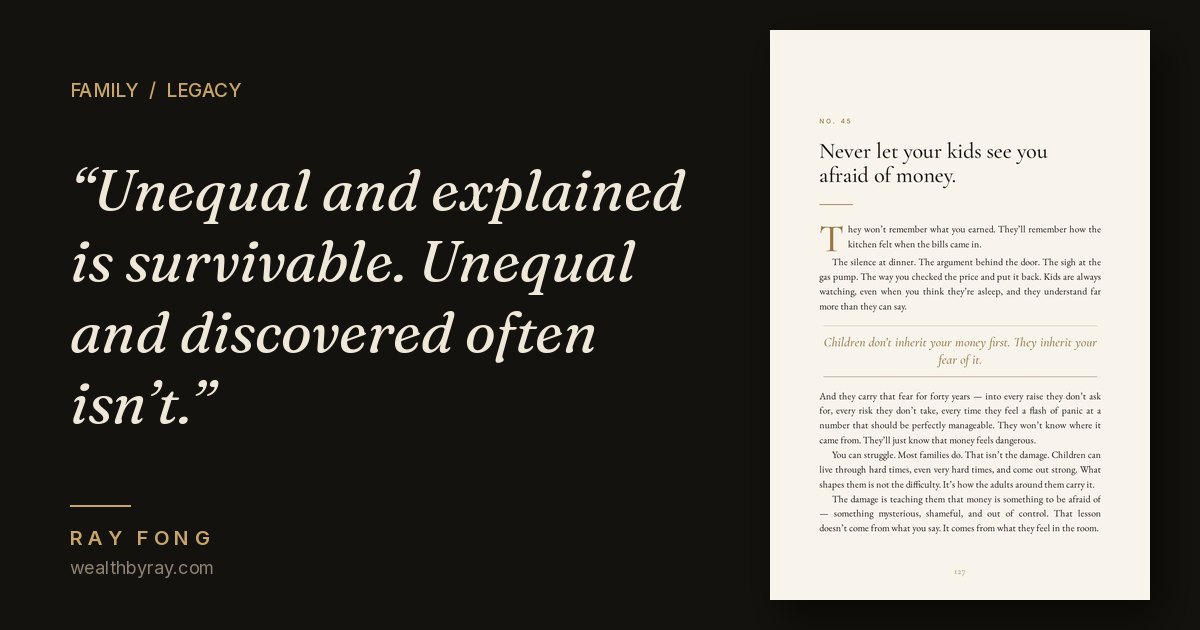
- Share anything unequal, and why. If one child gets more, or a charity gets a share, explain it now while you can answer questions. Unequal and explained is survivable. Unequal and discovered often isn’t. If you’d rather give some of it now, check the limits with the gift and estate tax calculator.
- You can keep the numbers private. “There will be something for each of you, and it’s organised” is enough for many families.
The exact words to open the conversation
- “Nothing is wrong. I want to talk about the future while everything is fine, so it never has to be a hard conversation later.”
- “I’d like you to know what I’ve set up and why, and I want to hear your questions.”
- “I’ve asked your brother to be executor. That’s not because I love him more. It’s because he lives close by.”
- “I’ve decided to leave the house to all three of you equally. If none of you wants it, it will be sold and split.”
- “Your mother and I want to help with the grandchildren’s education. That money is set aside separately.”
- “I’m not going to share exact numbers today. I want you to know it’s organised and you won’t be left guessing.”
Unequal and explained is survivable. Unequal and discovered often isn’t.
How to run the meeting
- Pick a calm time, not a holiday dinner. Tell them in advance what you’d like to talk about.
- Get everyone together, in person or on a video call, so nobody hears a different version.
- Talk values first. What the money is for: security, education, a family home, giving back.
- Then the plan: who does what, where things are, anything unequal.
- Invite questions and don’t argue with feelings. “I understand” goes a long way.
- Write a short summary afterwards and send it to everyone.
If you’re the adult child
You can start this too, gently. Try: “I don’t need to know any numbers. I just want to make sure that if something happens, I know where things are and what you’d want.” Make it about their wishes, never about what you’ll receive.
If your parents don’t have a plan yet, it may help to read living trust vs. will and payable-on-death accounts vs. a living trust together first.
The Quiet Rules
Seven of the rules Ray’s family has kept for three generations, including how to talk about money without a fight.
Read it free →Questions people ask
When should I talk to my children about inheritance?
While you are healthy and nothing is urgent, ideally as soon as you have a will or trust in place, and again every few years or after big changes such as a marriage, divorce, sale of a home or a new grandchild.
Do I have to tell my children how much they will inherit?
No. Many parents share the plan, who is in charge and where the papers are, without sharing amounts. What matters most is that nothing important comes as a surprise.
How do I explain leaving more to one child?
Explain it yourself, while you are alive, with your reason: one child cared for you, another already received help with a house, or one has greater needs. An unequal plan that is explained in advance causes far less conflict than one discovered after a death.
Should all the children be in the same conversation?
Yes, if possible. When everyone hears the same thing at the same time, there is less room for different versions and suspicion later.
General education, not financial, legal or tax advice. Rules vary by state and country; speak with a licensed professional about your situation. About Ray.