How to say no when family asks to borrow money
 Ray Fong · Updated November 7, 2026
Keep it short, kind and final: “I love you, and I don’t lend money. That’s a rule I keep with everyone.” Don’t give a long reason, because every reason becomes something to argue with. If you want to help, offer something other than a loan: your time, a meal, a call to a lender, or a gift you can afford to never see again.
The first time a cousin asked me for money, I said yes. I didn’t want to be the man who said no to family. It took four years to get half of it back, and we haven’t been easy with each other since.
That’s the part nobody warns you about. The money is rarely the real cost. The real cost is that every family dinner afterwards has a number sitting at the table.
Decide your rule before anyone asks
A “no” is hard in the moment because you’re deciding under pressure, with someone you love looking at you. So don’t decide in the moment. Decide now, on a quiet afternoon, and write it down. Mine is simple: I don’t lend to family or friends. If I help, it’s a gift, and only an amount I can live without.
A rule does two things. It means you’re not judging the person, only following your policy. And it means your answer is the same for everyone, so nobody can say you played favourites.
12 lines that work
When you need time:
- “Let me think about it overnight. I’ll call you tomorrow.”
- “I don’t make money decisions on the spot. Give me a day.”
When the answer is no:
- “I love you, and I don’t lend money. It’s a rule I keep with everyone.”
- “I’m not able to do that, and I’d rather tell you now than let you wait on me.”
- “That doesn’t work for me. I hope you understand.”
- “Our money is already spoken for.”
When you want to help another way:
- “I can’t lend it, but I can help you sit down and look at the numbers.”
- “I won’t lend, but I can give you a smaller amount as a gift. You don’t pay it back.”
- “I can’t help with money, but I can help with the kids this week so you can work extra shifts.”
When they push:
- “I know it’s not what you wanted to hear. My answer is still no.”
- “I’m not going to change my mind, and I don’t want this to come between us.”
- “I care about you too much to keep arguing about money. Let’s talk about something else.”
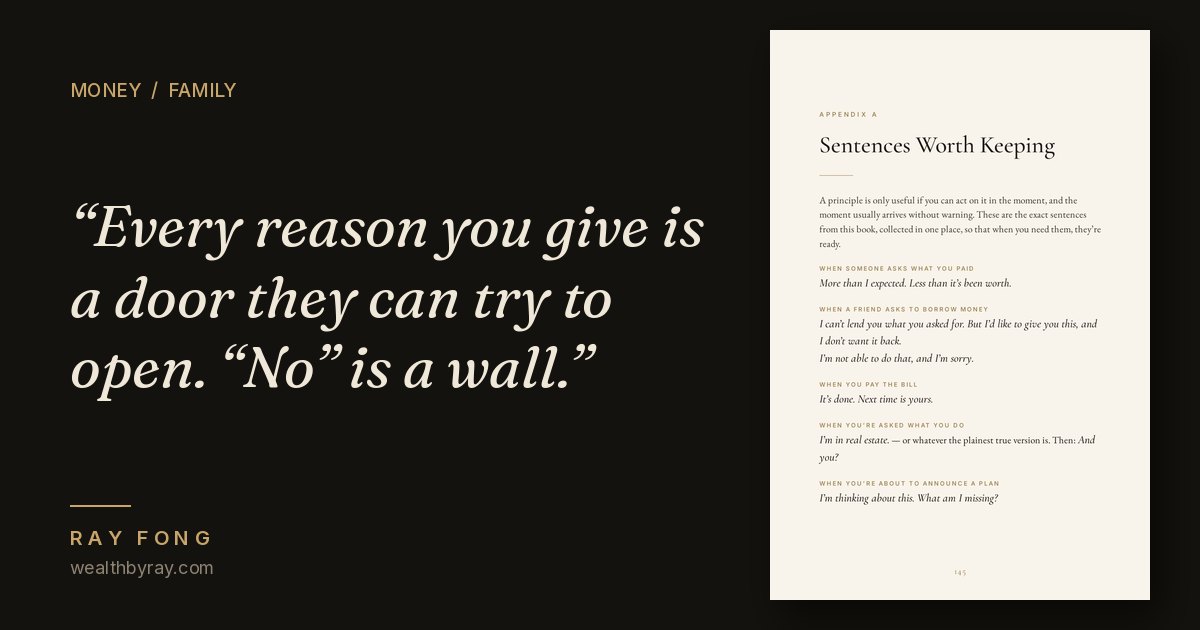
Every reason you give is a door they can try to open. “No” is a wall.
What not to say
- A long explanation. Explaining invites negotiation. “Why not?” deserves the same short answer again.
- “Maybe later.” It sounds kind, but it’s a promise, and they will come back to collect it.
- “I’m broke.” If it isn’t true, it will be found out, and now the problem is that you lied.
- Anything about their past mistakes. You can say no without making them feel small.
When your adult son or daughter asks for money
Saying no to your own child is the hardest version of this. You remember them small, and part of you still feels it’s your job to fix things. But a grown child who learns that a parent always pays rarely learns to stop needing it. A kind, clear no is part of raising them, even at thirty-five.
- “I love you, and I’m not going to lend money. I’d rather help you solve this than pay for it.”
- “Let’s sit down together and look at your budget. If we find the gap, we’ll find the fix.”
- “Your mother and I need this money for our retirement. If we run out, you’re the ones who will have to help us.”
- “I’ve helped before, and I don’t think helping again is good for you. I believe you can handle this.”
Treat every child the same way. If you do give one of them money, decide whether it is a gift or part of their inheritance, and tell the others. Unequal help that nobody explains is how siblings stop speaking. I wrote about that in how to talk to your adult children about inheritance.
If you decide to lend anyway
- Only lend what you could lose. Assume you may never see it again. If that thought scares you, the amount is too big.
- Write it down. The amount, the payments and the date, signed by both of you. It feels formal, but it protects the relationship from two different memories.
- Never co-sign. Co-signing isn’t a favour. If they miss payments, the debt is legally yours and so is the damage to your credit.
- Don’t lend from retirement savings. You can’t get those years back.
The quiet truth
People who ask once and hear a calm, kind no usually ask somewhere else and come back to dinner as if nothing happened. People who hear “maybe” keep circling. A clear answer is often the more loving one. For more on protecting your privacy around money, read 5 things to never say when someone is fishing for information.
The Quiet Rules
Ray’s free book has the exact words for the moments money gets personal.
Read it free →Questions people ask
Is it rude to say no when family asks for money?
No. Saying no calmly and kindly is not rude. It is often kinder than a reluctant yes that turns into resentment. Keep it short, warm and the same for everyone.
How do I say no to my son asking for money?
Say it once, warmly and without a long reason: 'I love you, and I'm not going to lend money. I'd rather help you solve this than pay for it.' Then offer real help, such as going through his budget together. Treat all your children the same way.
Should I lend money to my adult child?
Only an amount you could afford to lose, and ideally as a gift rather than a loan. Never lend from retirement savings, and avoid co-signing, because the debt becomes legally yours if they don't pay.
What do I say if they get angry?
Stay calm and repeat your answer without new reasons: 'I know it's not what you wanted to hear. My answer is still no.' If it turns hostile, end the conversation and say you care about them too much to keep arguing about money.
How do I help without lending money?
Offer time, practical help, a review of their budget, a call with a lender or credit counselor, or a small gift you never expect back.
General education, not financial, legal or tax advice. Rules vary by state and country; speak with a licensed professional about your situation. About Ray.