How to respond when someone asks how much you make
 Ray Fong · Updated October 29, 2026
You don’t owe anyone your salary. The classiest answers are short, warm and final: “Why do you ask?”, “Enough to sleep well,” or “I keep that part private, but I’m happy with where I am.” Don’t get defensive, don’t lecture them about manners, and don’t fill the silence that follows. Then change the subject.
Ray explains it in under two minutes.
Some questions aren’t really questions. They’re a way to measure you. What you earn, what you paid, what you’re planning. The people who ask aren’t always bad people. But the answers rarely help you, and they can’t be taken back once they’re out.
It took me most of my life to learn how to answer them without being rude and without giving myself away. Here are the lines I use, and five I stopped saying.
12 lines for “how much do you make?”
Turn it back, politely:
- “Why do you ask?”
- “Are you thinking about a change yourself?”
Answer without a number:
- “Enough to sleep well.”
- “I keep that part private, but I’m happy with where I am.”
- “More than I used to, less than I’d like.”
- “My father taught me never to discuss money or politics at dinner. I’ve kept one of those rules.”
When they ask what you paid:
- “It was worth it to me.”
- “I don’t remember the number, only that I’m glad I did it.”
When they push:
- “I’d rather not share that. How’s your work going?”
- “You’ll have to let me keep one mystery.” (with a smile)
At work, where the context is different:
- “I’d rather not share the exact figure, but it was a step up from my last role.”
- “If you’re researching pay for a role, I’m happy to point you to the salary data I used.”
Notice what these have in common. None of them is rude, none of them explains itself at length, and every one ends the topic.
5 things to never say
1. “That’s none of your business.”
It’s true, but it sounds defensive, and it tells the other person they’ve found something worth protecting. Their curiosity doubles. Etiquette writers make the same point: calling out someone’s rudeness rarely ends well.
2. “Not enough.”
It sounds modest, but it’s an invitation to keep digging. “Not enough compared to what?” The conversation is now about your salary. Say “enough to sleep well” instead. It’s warm, it’s final, and it says something more valuable than a number.
3. The price of what you bought
The moment someone knows what you paid for your car, your watch or your house, they’ll judge every purchase you make after it. Some will envy you. Some will pity you. Either way, they now hold a number that belongs to you.
4. “It stays between us.”
Nothing stays between two people. Not because people are dishonest, but because secrets are heavy and people put them down. If something can’t be repeated, don’t say it at all.
5. Anything that fills the silence
This one took me forty years. A skilled negotiator, a nosy relative or a salesman will ask something, and then simply go quiet and wait. Most people can’t stand silence. They start talking to fill it, and that’s when they say too much.
Don’t fill it. Smile, take a sip of your coffee, and let the silence sit there. Whoever breaks it usually gives something away.
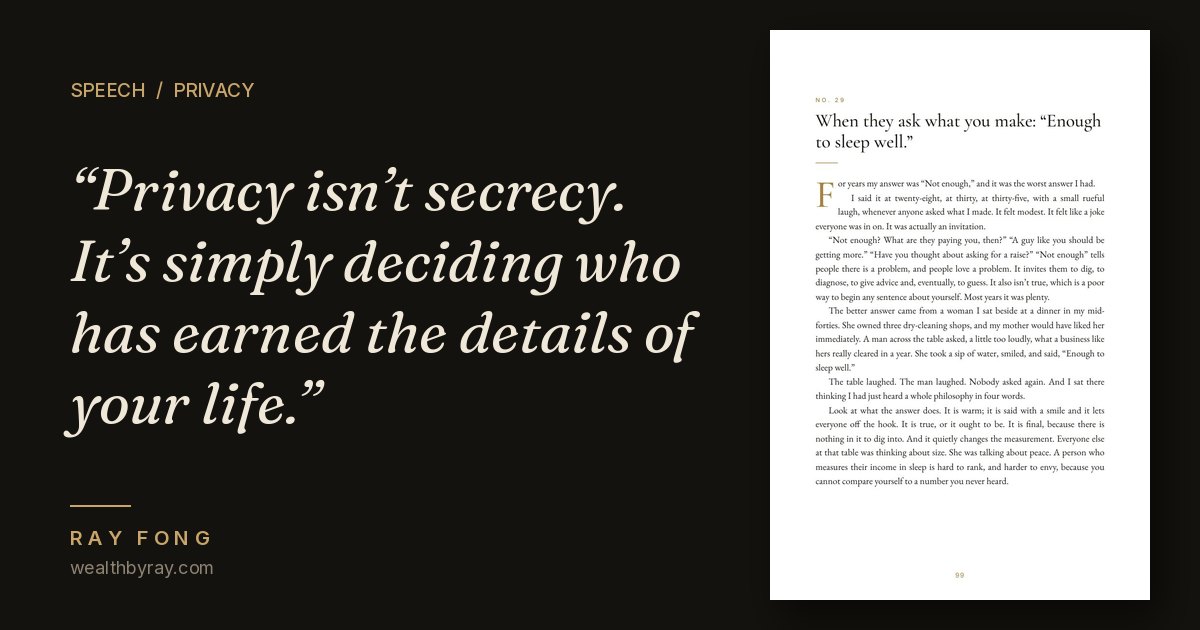
Privacy isn’t secrecy. It’s simply deciding who has earned the details of your life.
When it’s worth sharing
Privacy isn’t a rule against all money talk. There are people who have earned the number: your spouse, your financial planner, and eventually your adult children when it’s time to plan what happens to the family’s money (I wrote about how to have that talk). Colleagues comparing pay to make sure they’re treated fairly is also a different conversation from a neighbour’s curiosity. Decide who is in that circle on purpose, not in the moment.
Why this matters for money
Quiet people are harder to sell to, harder to borrow from and harder to pressure. You’ll get fewer “investment opportunities” from friends of friends, fewer loan requests and fewer people adjusting their price to what they think you can afford. And when the loan request does come, it helps to have the words for saying no ready. Discretion isn’t only good manners. It protects your wealth. It’s the heart of stealth wealth.
The Quiet Rules
Ray’s free book has the exact words for the moments money gets personal.
Read it free →Questions people ask
Is it rude to ask someone how much they make?
In most social settings, yes. Etiquette experts generally treat salary as private, and you are under no obligation to answer. At work, conversations about pay fairness are a different and often legitimate context.
What is a polite way to avoid saying your salary?
Keep it short and warm, then change the subject: “Why do you ask?”, “Enough to sleep well,” or “I keep that part private, but I’m happy with where I am.”
How do I answer when someone asks what I paid for something?
“It was worth it to me” answers the feeling behind the question without giving a number.
What if they keep pushing?
Repeat a calm, short line once (“I’d rather not share that”) and move the conversation elsewhere. Avoid explaining or lecturing; explanations invite negotiation.
Should I tell family how much money I have?
Your spouse and, at the right time, your adult children may need to know enough to plan. Wider family and friends usually don’t, and sharing can invite loan requests and pressure.
Watch the reel this post came from →
General education, not financial, legal or tax advice. Rules vary by state and country; speak with a licensed professional about your situation. About Ray.