What to say when someone disrespects you at work (without losing your job)
 Ray Fong · Updated November 7, 2026
Stay still, keep your voice level and use one of three lines: “I’m surprised you felt comfortable saying that in front of everyone,” “I don’t let anyone speak to me like that. If you have something professional to say, say it,” or “Sorry, I didn’t catch that. Could you repeat it?” Each one moves the attention off your reaction and onto their behavior. If it keeps happening, write it down and take it to your manager or HR.
Ray explains it in under two minutes.
When I was twenty-four I worked for a man who liked an audience. One morning, in front of the whole crew, he called my work “garbage” and asked if I had been raised in a barn. My blood boiled. I needed that job, and I said nothing. I went home and replayed it all night.
A week later he tried it on a woman named Dolores, who had been there longer than anyone. She put down her pen, looked at him and said, very quietly, “I’m surprised you’d say that in front of everyone.” The room went silent. He mumbled something and walked off. He never did it to her again.
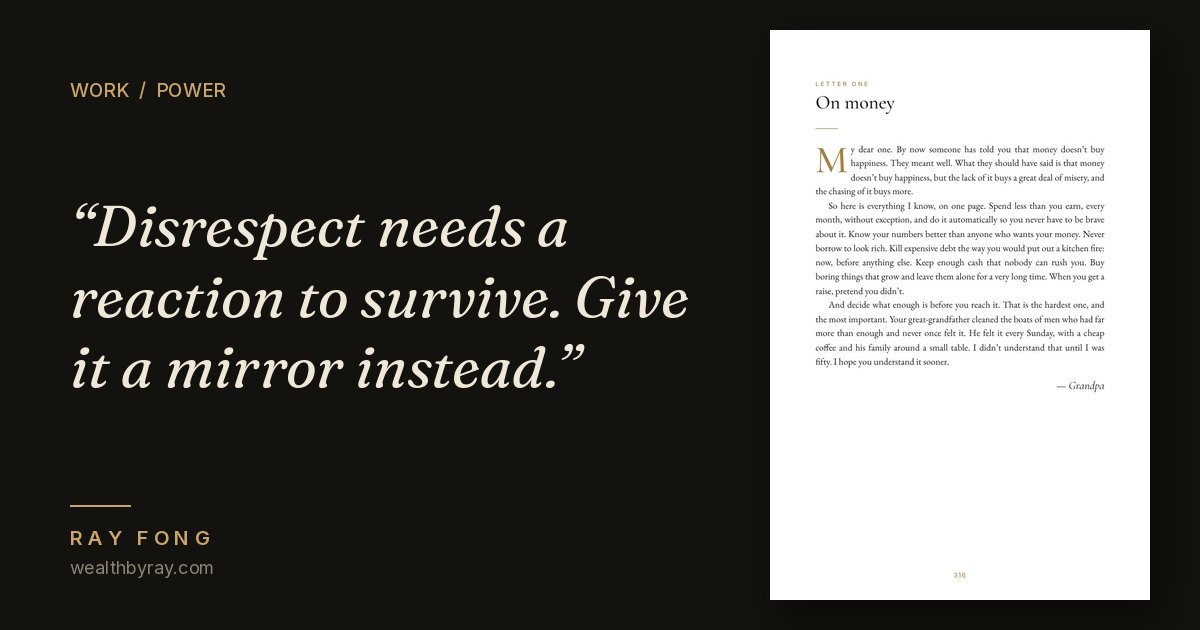
Disrespect needs a reaction to survive. Give it a mirror instead.
Why you feel trapped
Most people respond to disrespect at work in one of two ways. They stay silent and look weak, or they react emotionally and damage their own reputation. Both feel bad because both hand control to the other person. And it isn’t a small problem: in surveys of thousands of workers, most said they’d been treated rudely at work, and many cut their effort or time at work because of it (Porath & Pearson, Harvard Business Review).
There is a third way: a calm, short line that ends the moment without starting a war.
Three responses that shut it down
1. Name it, calmly
Look at them, wait a beat, and say: “I’m surprised you felt comfortable saying that in front of everyone.”
You haven’t insulted them. You’ve simply described what they did, out loud. The attention moves off your reaction and onto their behavior, and everyone in the room is now thinking the same thing.
2. Draw the line
Stay completely still, hold eye contact and say: “I don’t let anyone speak to me like that. If you have something professional to say, say it.”
Then stop talking. The silence after that sentence does more work than any comeback. Don’t fill it.
3. Make them say it twice
Say: “Sorry, I didn’t catch that. Could you repeat it?”
Most disrespect sounds much worse the second time, and most people won’t repeat it. They soften it, or they drop it. Either way, you didn’t raise your voice once.
Delivery: the part people skip
- Pause before you speak. Two seconds of silence tells everyone you are choosing your words, not losing them.
- Lower your voice. Loud sounds hurt; quiet sounds certain.
- Don’t smile to soften it. A nervous smile cancels the sentence.
- Say it once and move on. Go back to the work. That shows the comment didn’t knock you off balance.
If it keeps happening
- Write it down the same day: date, time, exact words, who was there.
- Talk to your manager or HR, with your notes, and keep it factual: what was said, how often, how it affects the work.
- Know the line between rude and illegal. If the disrespect is about your race, sex, age, religion, disability or another protected trait, it may be harassment. In the U.S. the EEOC explains your rights and how to file a complaint.
What really makes it hard
Notice what makes these moments so painful. It isn’t the words. It’s the paycheck. When you know you can’t afford to walk out, every insult lands twice.
When you don’t need the job, the conversation changes completely. You speak more calmly because you have nothing to protect. That is what building wealth really gives you. Not things. Options. (And the people with the most options usually don’t look rich at all.)
The Quiet Rules
Ray’s free book: how to stay calm when it counts, and how to build the kind of wealth that gives you options.
Read it free →Questions people ask
How do you respond to disrespect at work professionally?
Pause, stay calm and use one short line, such as “I’m surprised you felt comfortable saying that in front of everyone” or “If you have something professional to say, say it.” Then go back to work.
What do you say when your boss talks down to you?
Keep your voice level: “I don’t let anyone speak to me like that. If you have feedback on the work, I want to hear it.” If it continues, document it and speak to HR.
Should I confront a coworker who disrespected me in front of others?
Address it briefly and calmly in the moment, or privately soon after. A short, factual sentence works better than an emotional reaction.
When is disrespect at work harassment?
When it targets a protected trait such as race, sex, age, religion or disability, or becomes severe or pervasive. In the U.S., the EEOC explains how to report it.
Watch the reel this post came from →
General education, not financial, legal or tax advice. Rules vary by state and country; speak with a licensed professional about your situation. About Ray.